Tuesday, October 30, 2012

Meet Me Down On Birch Steet... Bring the Saint-Julien


Last week's first rainstorm of the season did nothing to dissuade the BNO--aka the Birch Street Boys--from its first road tour in ages. Veteran road manager, Sandy, who apparently knows about tropical depressions, said beforehand he has everything under control and that we will be dining curbside al fresco--the only space at the tiny Birch Street restaurant in Palo Alto where our party could be accommodated. In a brash display of bravado on that opportune night Sandy dressed up in his Aloha shirt.

Lo and behold, the rains stopped, the clouds parted, and the light from a glowing hunter's moon shone down upon us. It was biblical.


I quickly gulped my glass of Monthuys Brut Reserve Champagne, it was crisp, full, and fruity. A good, crowd-pleasing bubbly.

(Kevin's note: fresh citric, with apple, high proportion of Pinot Meunier, fruity with good acidity and nice floral character. Fruity, fresh a wine for real enjoyment. Went perfectly with the crab dish)

The theme for this dinner was the Medoc wines of Saint-Julien. For many long-time Bordeaux drinkers this is a favorite region to pluck. Saint-Julien's lack of first growth yet preponderance of overachieving second growths made it the source for best value top Bordeaux for several decades lasting through the end of the previous millennium. Situated on rocky, well-drained soils by the banks of the Gironde, its wines, traditionally dominated by Cabernet Sauvignon, have a distinctive character--upright, austere, tannic, and needing many years of cellaring to achieve the lovely elegance and finesse that is regarded by some as the epitome of claret. Saint-Juliens are very similar to the wines of their close neighbor to the north, Pauillac, but are somewhat less powerful, which I  believe plays into their more graceful style.

What better way to size up Saint-Julien than with a clutch of its well-aged wines, particularly from Chateau Beychevelle, the fourth growth estate that is almost always grossly underrated by both wine writers and wine critics. The four old vintages of Chateau Beychevelle we drank were all superb, bolstering the reputation of Saint-Julien and exposing the utter failure of wine critics to judge these vintages. The 1962 Chateau Beychevelle seems youthful still. with just a breath of oxidation. It's at that pinnacle where freshness intersects with finesse and elegance. The 1978 Chateau Beychevelle was the most edgy Saint-Julien of the bunch. Very Cab, firm and textured with its rich tannins intact. Masculine and youthful in color. Unsurprisingly the most plush was the lovely 1982 Chateau Beychevelle, its fruit plump and soft, and overall as seductive as a lap dance. We had two fine examples of the 1970 Chateau Beychevelle, with the first one in a 750ml bottle and the second in a surprise magnum. For some reason I thought the 750ml was drinking better; it showed not only a freshness but also an appetizingly rich concentration that the leaner, more acidic magnum seemed to lack. The magnum was presented blind, and so I guessed it was perhaps a '64. Anyway, in the end it just added to my suspicions about the variability in 1970s Bordeaux bottlings--hard to predict what you'd get.

(Kevin's note:  1962 Beychevelle—supple fragrant with raspberry and a little spice, with very good balance and elegance-my favorite wine of the night. 18 1970 Beychevelle (.750 ml)—cedar and matchstick, (I wanted to light up my English blend tobacco right then), lighter bodied, not that concentrated but nice smoke and cedar on the mid palate. 17-17.5 1970 Beychevelle (magnum)—harder tannins but fruit not as strong. I liked the 750 more. 1978 Beychevelle—hearty, chunky style. I couldn’t figure out where this was going. The tannins were strong but seemed a little off also. 16.5-17. 1982 Beychevelle—Powerful concentrated, lots of promise, blackberry and vanilla, tobacco cedar cabernet nose--17.5-18.)


Aside from the 1982 Chateau Beychevelle, there were two other 1982 Bordeaux on the table. One was the great 1982 Chateau Leoville-Las Cases. I'm not the biggest 1982 Bordeaux fan, there are not many wines in this vintage that have wowed me but the Leoville-Las Cases is stupendous, just a notch below the greatness of another second growth, the 1982 Pichon Lalande--it would be most interesting to do a mano-a-mano between the two. Notwithstanding its proximity to Chateau Latour, the Las Cases is solid Saint-Julien, it is upright, not so much voluptuous, and there is a firmness underneath the 1982 fat. Altogether, the wine is aristocratic.

(Kevin's notes: very tight focus, On palate great concentration enormous depth, power. Graphite, cassis, wow. 19-19.5)

My favorite wine of the evening, though, was the 1982 Chateau Gloria. A wine with a magical purity. Amidst the richness, the elegance shines through with a lovely expression--cassis, mint, and tea leaves in fresh high tones. Unlike the Las Cases, which is a meal by itself, the Gloria demands that you take a bite of that tender quail after each sip. And maybe a forkful of that grass-fed filet as well, then you wash it down with the Gloria. Hallelujah! G-L-O-R-I-A!

(Kevin's notes: Ruby color, tobacco with fairly oaky nose, but palate surprisingly austere (a good thing!)— but not because of lack of fruit, plenty of that also. 17)


Any tasting of Saint-Juliens should pay respects to Anthony Barton, who for many years during the 1990s and early 2000s refused to greedily raise his price. The 1990 Chateau Leoville-Barton only gets more gorgeous with time. Violets-scented streaked with Earl Grey and raw beef. On the palate it was so '90, opulent and velvety.

(Kevin's notes:  Rich cedary nose, nice cab, powerful wine, upfront fruit and spice on the finish. Great future.  17.5—18)


A footnote to this tasting was the 2007 Domaine du Jaugaret. It is a unique estate not just in Saint-Julien but in all Bordeaux. Encompassing just a mere 1.3 hectares, it has been owned by the Fillastre family since 1654. However, the estate will end with Jean-François Fillastre, who is almost 70 years-old, as he has no heirs. About 80 percent Cabernet Sauvignon that's been aged in old oak barrels for 30 months. It has more of a varietal wine character rather than a blended Bordeaux, with young Cabernet flavors of dense blackberries, olives, and toasty oak. Surprisingly reminiscent of an old-style Napa Cabernet like Inglenook or a modern-day version like Dominus.


Dessert arrived with the 2001 Chateau Rieussec. Obviously an infant, but a marvelous treat to taste after a decade. Very rich and concentrated, stuffed with apricot jam, raw honey, and candied orange peel. Overwhelming on the palate.

(Kevin's notes: lots of zest and acidity, told very high residual sugar but wouldn’t notice it. mandarins and pineapple, lengthy and tangy.)


The Birch Street Boys

The dinner left me with a good taste of Bordeaux in my mouth that I haven't felt in a long time. This road tour rocked.

Monday, October 22, 2012

Special Tasting of Great Italian Reds, Plus Food From La Ciccia


When: 26th October 2012
Friday 5pm-6:30pm

Where: Vineyard Gate
238 Broadway, Millbrae CA

Here is a special tasting of great Italian reds you don't want to miss. Plus, our good friend, Massimiliano Conti, chef and co-proprietor of La Ciccia in San Francisco, is pitching in. Massi will cook for us his specialty Sardinian pasta dish so we could enjoy these great red wines even better! I know it's tough to get a reservation at La Ciccia these days, hence we will just bring La Ciccia to Vineyard Gate!

We will feature some of the best wines from producers represented by Dominic Nocerino of Vinifera Imports. Dominic is one of the pioneers of Italian wines in the US. Over the past 40 years he has introduced producers like Fontodi, Gaja, Felsina, Valdicava, Braida, and Brigaldara in the US market. He has a keen palate and insight on the potential of a wine estate, taking on producers before they become world famous.

For our tasting we will highlight some of the greatest producers from Vinifera Imports. Together with Pietro Straccia from Vinifera Imports we will discuss each wine during the tasting, talk about the producers, and answer questions. We want this as much of a learning experience as possible while enjoying the wines.

Here is the lineup of wines to be poured in the tasting:

Soligo Prosecco Brut NV

Pelissero Dolcetto d'Alba "Munfrina" 2010 - Giorgio Pelissero crafts one of the greatest of all Dolcetto d'Alba. Beautiful and classy. 91/100 Antonio Galloni, Robert Parker's Wine Advocate

Sant' Elena Venezia Giula IGT Red "Quantum L'Autoctono" 2006 - from 100% Pignolo grapes. 94/100 Antonio Galloni, Robert Parker's Wine Advocate

Castello Romitorio Sant' Antimo Rosso "Romito del Romotorio" 2006 - rich, powerful "Super Montalcino" blend of Sangiovese, Cabernet Sauvignon, and Canailo made by one of the rising stars of Brunello producers. 92/100 Wine Enthusiast

Valdicava Brunello di Montalcino Riserva DOCG "Madonna del Piano" 2004 - rare single-vineyard Brunello Riserva. 96+/100 Antonio Galloni, Robert Parker's Wine Advocate. 96/100 James Suckling

Brigaldara Amarone della Valpolicella DOC "Casa Vecie" 2007 - single-vineyard Amarone from a unique terroir! 94/100 Antonio Galloni, Robert Parker's Wine Advocate

Fratelli Oddero Barolo DOCG Mondoca di Bussia Soprana 1996 - from one of the greatest vintages for Barolo! A single cru from the Monforte d'Alba zone, known for powerful, structured Barolos. 91/100 James Suckling


We will offer special pricing on all the wines good only during this event!

Small-Bites Menu to accompany the tasting:
Massimiliano Conti chef and owner of La Ciccia Restaurant in San Francisco will be baking some of his house made bread and preparing specifically for Vineyard Gate a staple of his Sardinian gem.... Malloreddus a sa Campidanese!


Malloreddus
Semolina Gnochetti with slow cooked Pork meat Sugo and 12 Months aged Pecorino Cheese of Sardinia!
Fontodi Oil
And with the La Ciccia bread, we'll be tasting a very special extra virgin olive oil produced by the great Tuscan estate Fontodi. This hard to find, small production olive oil was personally selected by Jamie Oliver for his Fifteen Shop in London. Fontodi Olive Oil is hand picked and crushed within hours in the estate's "Frantoio" (Olive Press). The result is an exquisite Real Extra Virgin Olive Oil that will compliment our tasting!


Total cost for this special tasting event, which includes a taste of all the wines and the special small-bites menu, is just $55.00/person payable to Vineyard Gate upon your reservation.  Please note that reservations are final and non-refundable. You will be responsible for finding your own replacement if you cannot come. We have very limited spots for this event. To reserve, please call us at 800.580.8588.

Sunday, October 14, 2012

Oh! To Be '29!


Folks born in 1929 have an enviable gift: they age more gracefully than others. Dick Clark was the eternal teenager, it was hard to guess his age as he kept on rockin' till the end. For decades the actor Christopher Plummer got away with looking exactly the way he did back in 1965 in Sound of Music. And then there's the perennial character actor both on TV and in films, James Hong; his unchanging voice is instantly recognizable from Faye Dunaway's butler in Chinatown to Mr. Ping in the Kung Fu Panda animated films. Who else but Barbara Walters should be featured in an Energizer advert, as she's been broadcasting for the past 40 years and apparently still going!


I'm fortunate to have two indefatigable friends, Ben and Mayon, who are both '29ers. We celebrated both their birthdays just a couple of weeks ago with an inspired dinner replete with memorable wines, that paid tribute to their their graceful resilience.

To start, we poured Champagnes. The 2002 Dom Perignon lives up to its hype. Showing youthful greatness. Big, fresh, vivid flavors. Very convincing. With all the preoccupation these days with tiny, artisanally produced grower-producer Champagnes, I am amazed how this mass-produced tête de cuvée with almost 2 million bottles cranked out each release remains one of the best there is.

(Notes from the group:  Young, wound up tight, a bit asleep on the nose.  A bit yeasty and medicinal, not in a bad way. Rich, glycerin, sweet, mouth coating.)

Shifting quickly to 1998 Veuve Clicquot La Grande Dame, the difference with the Dom is immediately noticeable. The La Grande Dame is lighter in comparison and possessing a sinewy, more svelte body. This 1998 also showed advanced notes. Tasting mature, with a smattering of oxidative, nutty flavors, I believe that at 14 years there is no more reason to wait.

(Notes from the group:  not as big as the Dom, a bit more mature, some nuttiness.  Strong, explosive effervescence initially, toned down pretty quickly.)


I've long regarded the vintage Delamotte as one of the best buys in vintage Champagne. The house is owned by the same folks who own Salon--the Laurent-Perrier group--in fact the two estates are next to each in Le Mesnil sur Oger and are managed and produced by the same team. the 1990 Delamotte is so rich and fresh, unbelievably youthful given its 22 year existence and the ripeness of the vintage. It is very mineral with a big, long finish. I would say, this Champagne if stored impeccably the way its been since release would easily age another 20 years.

(Notes from the group:  Lots of minerality, a bit closer to mature, more yeasty and Bread like, but still rich.)


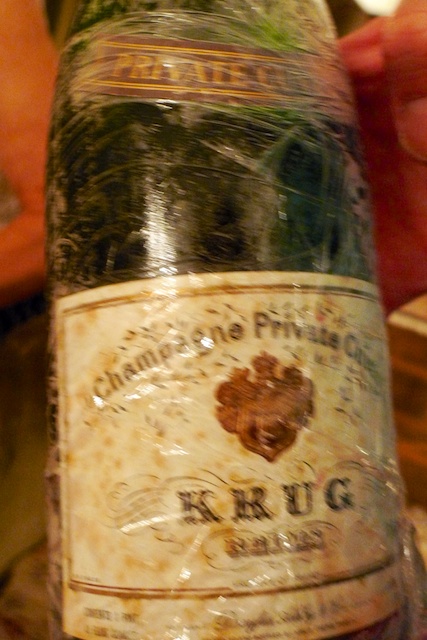
Frankly, I'm not sure if the Krug Private Cuvee we drank is the same as Krug's Grand Cuvée. I assume it is. This bottle, according to Paul, is circa late 1960s which would put it at close to 50 years since disgorgement. Still very refreshing, with no sign of tiring. It has Krug's luxurious richness--plush velvet and hand-stitched leather--and refinement.

(Notes from the group: On the nose, a touch of yeast, a touch of orange and rose petal, and almost a bit of Bordeaux mustiness/mushroomy quality. In the mouth, bacon fat, bone marrow feel.  Fresh, not super long, but very nice. Superb wine, beautiful.)


From the kitchen came out a decadent plate of bone marrow on toast, and along with it two bottles of old Sherry. This is one of the most delightful pairings I've learned from Ben and Mayon. The Osborne Amontillado was perhaps bottled in the late 1950s through early 1960s. Bone-dry with caramel toast and toffee flavors, raw and aggressive on the palate. The fatty bone marrow seemed to soften the Osborne's rough edges.

A smoother Amontillado was the A.R. Valdespino Rare Amontillado Signature Series. Kevin read out the back label which said that it was bottled after aging for 106 years! Not surprising since Valdespino is one of the oldest bodega in Jerez. Very smooth, with spicy, licorice notes, more off-dry, hinting of Madeira. This is very, very good.

(Notes from Kevin:  Orange/dark amber colour, moderately aromatic with a little sandalwood, good concentration dry but not bone dry, excellent length, wood, menthol, coffe grounds, excellent length,acidity good with a certain mildness that while made for a nice mouth feel, a little more acidity would have sealed the deal for me. Still pretty high end. Only 100 cases made


A juicy plate of crisp tempura soft-shell crabs accompanied the flight of two white Burgundies. The younger 2004 William Fevre Chablis Les Clos I've enjoyed a few times before and after release, including once at the domaine and also at a trade tasting where it was presented side-by-side with the Les Preuses. I confess I'm more of a Les Preuses fan, but the Les Clos is absolutely marvelous. Still tight, but maturing into a more elegant Chablis. Sharp, fresh, and racy with a lot of power in reserve.

(Notes from the group:  Chablis lemon oil, acid, and harshness is beautifully integrated, richness has emerged, with a silky minerality that is very rare.   Probably close to peak, no flabbiness, but the rich oily component is there.)


A candidate for wine of the night is the 1977 Domaine Leflaive Puligny-Montrachet Clavoillons. I must say one thing before talking about this wine. Every time I get a chance to drink Domaine Leflaive pre-1990 I'm never disappointed. In fact, I'm not sure if there was any quality improvement at all after 1989 when the tandem of Pierre Morey and Anne-Claude Leflaive took over from the previous regime, and the vineyards were later converted to biodynamics. Though the domaine cites 1717 as its start, in actuality the domaine was created in 1920 when Joseph Leflaive together with his right-hand man, François Virot, planted vines and bottled under the estate's label for the first time. From 1920 to 1989 François Virot and his son, Jean, who succeeded him, were effectively directing the estate's operations, both in the vineyard and cellar. After Joseph Leflaive's passing in 1953, his sons Vincent and Jo took over, but they never lived in the estate at all, leaving most operations to François and his son.

I relate this background on the domaine because Domaine Leflaive is so famous today and its wines, especially older vintages much sought-after. Everyone knows the Leflaives, even Pierre Morey, but few know about the Virots, especially François (save for Burgundians and insiders), who was one of Burgundy's greatest vignerons.


The 1977 Clavoillons had a breathtaking freshness, its Puligny fruit pure and precise. With time in the glass it only brightened. Notes of hazelnut, lime citrus oil, and plenty of mineral. Long and elegant on the palate with a distinct trail of spice. From a crappy vintage in Burgundy, this is a triumph!

(Notes from the group: On the palette , rich round, opulent. Lemon, citrus oil, boytritus, white flower.  Fruit is in the background, but jasmine, white peach, apricot, lime, moving to tropical fruits, but not over ripe.)


A preliminary red was a bottle of 1984 Château Margaux, which was much better than one might expect from a vintage that is skipped by experts when discussing Bordeaux vintages. It had a good concentration, clean flavors without funk, and altogether well-balanced and a pleasant drink. It is evident that the estate, which suffered during the '70s and ended being sold, was on an upward trajectory already.

(Notes from the group: Great color, tobacco, elegant  On the nose, violet, iron and rose petal.  Mouth feel is a touch thinner than you would expect, but elegant, silky and quite lovely.  Fruit is ripe, but just starting to dry,  a touch of cedar, medium length.)


Looking at the two bottles of Château Palmer, one from 1929 and the other 1970, the difference is not only striking but there seems little if any continuity with the labels. The ownership of the estate was different for each vintage. Yet despite all these incongruous externalities, Palmer is Palmer. I confess to a bias, it is one of my few favorite Bordeaux. Its distinctive quality carries through in both vintages, with its delicate richness, leafy violet scents, and plush texture. The 1970 Palmer, leaner than examples I've had on previous occasions, therefore more elegant and precise, has good concentration, a sumptuous palate, and really gorgeous tea leaf, autumnal aromas. It remains fresh and showed no sign of tiring. The 1929 Palmer is even leaner and sinewy. The aroma is still bright and perfumy and the palate remains refreshing, and though the fruit is past its prime the wine still conveys Palmer's class and elegance.

(Notes from the group:  1970 Palmer. Classic margaux elegance and perfume, a touch of gaminess on the nose.  Iron, terroir, dark/black fruits, deep rich mulberry, boysenberry black cherry.  A nice grapiness, which is unusual. good length, mouth filling and lovely. 1929 Palmer. Tannins fully integrated, in the background, with a touch dryness, but very balanced,  acids in the background. Soft, sweet, luscious, opulent.)


The red Burgundy flight consisted of the Grivots, a 1996 Jean Grivot Richebourg and a 1929 Moillard-Grivots Grands Echezeaux. These producers aren't really related, but then again in Burgundy one doesn't really know.

I find the 1996 Jean Grivot Richebourg still very tight, as many 1996s have shown to be. Grivot usually takes even longer than others to yield, yet there is very good promise here, as the fruit is fleshy and concentrated, high-toned as always with Grivot and quite firm.

(Notes from the group: Tight, lean and green on the nose, flawed by the competiton, not the winemaking.  Still way to young.  Richness is emerging, but a touch of acid, minerality, medicinal and herbal.)

Moillard-Grivot is an old negociant in Nuits-St-Georges that started around 1850 and made a ton of money exporting to Belgium. It still exists to this day. In its heyday under its various arms--Thomas-Moillard, Charles Thomas, Maison Moillard--Moillard-Grivot was one of the major vineyard owners in the Cote d'Or and the company still exists to this day. The 1929 Moillard-Grivot Grands Echezeaux was surprisingly fresh and tasty. A gorgeous wine for its velvety dark fruits tinged with spice and coffee.

(Notes from the group:  Sweet baked (but not cooked ) red fruits, almost a rhubarb or strawberry pie characteristic.  Palette is soft sweet, with good acidity long, mouth coating and a bit prickly or bramblely, artichoke, but fitting for the wine.)


With the dessert a 1977 Chateau d'Yquem appeared. It was good and tasty but, of course, with Yquem one always expects Valhalla and this vintage doesn't quite get you there.

(Notes from the group:  Nose is rocking, but taste seems off for the nose  A touch out of balance?  Caramel, burnt sugar on the sides and back of palette.)

But a major distraction for me was an interloping bottle of 1748 Justino Henriques Verdelho Solera! I don't know when this was bottled but it was definitely old. Amber-tawny hued, off-dry, high-toned and fresh. Dried apricot, toasted nuts, and malaga ice cream. Long and sustained mid-palate and an almost endless finish. What a rare masterpiece! Unquestionably the most unforgettable wine of the night. I can totally relate with Antonio Galloni of The Wine Advocate when he said in his notes about this wine: "Quite frankly, I had hard time moving on after tasting this elegant, complete wine." Madeira this good is indeed the king of wines.


You know it's a special occasion when Kevin pulls out his finest party threads from the closet even prior to Halloween. He was absolutely smashing in red! Our gratitude to Ben and Mayon for a memorable treat and for making us feel at least for this one night members of the exclusive club of '29ers.

Thursday, September 27, 2012

Special Tasting of Burgundies from Becky Wasserman/Veritas Imports and Napa Cabernets from Jones Family

Our special blockbuster tasting of Burgundies from Becky Wasserman/Vertias Imports and Napa Cabernets from Jones Family Wines this Saturday 29th September from 4pm to 6pm is not to be missed!


One of the Burgundy producers featured is Charles Vienot--a mciro-negoce headed by the brilliant Grégory Patriat, who prior to this spent 3 years with Domaine Leroy. We will feature three terrific Burgundies made by Grégory Patriat under the Charles Vienot label:
Puligny-Montrachet Corvée des Vignes, Charles Viénot 2008
Gevrey-Chambertin, Charles Viénot 2009
Chambolle-Musigny, Charles Viénot 2009


Aside from Charles Vienot, we will pour beautiful, yet affordable white and red Burgundies from top producers including Patrick Javillier, Benjamin Leroux, Camille Giroud, Joseph Garnier, and Vrignaud. And we will also feature wines from Napa's cult producer, Jones Family! Altogether 12 fantastic, different wines are included in the lineup

Total cost for this special tasting event, which includes a taste of all the wines and a special small-bites menu to accompany the tasting, is just $55.00/person. We have very limited spots for this event. For more details and to reserve, please call us at 800.580.8588.

Thursday, September 20, 2012

The State of Burgundy Today


Burgundy is more popular than ever, with a horde of new fans not just here in the US but even more so in booming Asia.

Alas, supply of Burgundy is unable to keep up with the increasing demand because it is made in small quantities. To make matters worse, Burgundy has experienced significant crop shortages since 2007, with 2009 the only year with a decent production. Both 2010 and 2011 were small production years, but the current vintage, 2012, is largely a disaster in many of the most important regions. Many producers are reporting harvest being down by over half of normal!

Thus, with demand growing and supply shrinking, it’s not hard to figure out a major problem in availability (and pricing) looming in the coming years, particularly for Burgundies from the best sites, which is generally in the Côte d’Or.

My best advise is to load up now, while good values still abound. Even in a few years time, you won't regret doing this.

Monday, September 3, 2012

Bastille Day Dinner 13th July 2012

Every year we do a Bastille Day wine dinner which is a great excuse to wine and dine. This year we had chef Patrick Farjas--ably assisted by his buddy chef Gaston--prepare for us a four-course, Lyonnais-inspired dinner. We featured an all-French lineup of wines imported by Martine's Wines, the pioneering French wine import company owned by Martine Saunier.

With chefs Gaston and Patrick manning the kitchen, how can we miss?


Patrick Piuze's Cremant de Bourgogne and 2010 Petit Chablis. Terrific start!


A Bastille Day soiree should always start with a tasty charcuterie plate.


With the charcuterie plate, the luscious '10 Georges Vernay Viognier and the '09 Herri Mina Irouleguy blanc were simply awesome! Some good spicy notes to go with the charcuterie.


And Paul entertained us during the night, singing French music and more jazzy stuff, really elevated the evening for everyone!


On a bed of pappardelle the best coq au vin! If I remember correctly I think the ratio was 9 bottles of vino per chicken, 2 days maceration, then roasted, fined, but without filtering. The broth was clean and packed with a smoky, earthy flavor. Fork-tender chicken. Yum! Merci Chef!


With Coq au Vin ya gotta have a Beaujolais! But Paul Janin's '10 Beaujolais-Villlages is extraordinary. From 60 year-old vines planted on just 1 hectare plot near Moulin a Vent. Handpicked and handsorted. 20% whole-cluster. Less than 400 cases are produced. Great vintage, beautiful with the coq!


2010 Bourgogne Rouge from Patrice Rion, one of the Burgundy producers we most admire! This comes from plots near Chambolle-Musigny, no wonder the finesse shows. Quite mineral as well. Enclosed in saranex-lined screwcap. Great with the coq au vin!


Gorgeous '10 Gilles Robin Crozes-Hermitage Papillon, floral and silky from young vines Syrah, great with the coq au vin! And ya gotta have Bordeaux for Bastille Day! This one the '10 Cru Monplaisir from an estate near Margaux and made by the former cellar master of Chateau Margaux, deeply concentrated, fabulous depth, amazing value!


Vacherin glacé, the special Lyonnaise dessert, whoo, what a treat! Orange and pomelo flavored cake at the bottom, ice cream, choco-banana meringue. Curnonsky and Larousse would be impressed!


Ah, the amazingly bright and pure '06 Chateau Les Justices Sauternes! 88% Semillon, a very high percentage. Honeyed and mineral, apricot flavors. Does wonders to the Vacherin!

Sunday, July 8, 2012

Together: Château de Puligny-Montrachet and Domaine de Montille


Etienne de Montille has been at the helm of both Domaine de Montille and Château de Puligny-Montrachet for the past ten years. Domaine de Montille, of course, is Etienne's family domaine. He was co-manager with his father, Hubert de Montille, in the mid-1990s, before taking full reins after 1999.

And around the same time, in 2001, Etienne was handed management of the underperforming legendary estate of Château de Puligny-Montrachet, which owns parcels in the glittering vineyards  of Puligny and neighboring Meursault. Etienne immediately went to work, lowering yields, converting the vineyards to organic and to biodynamic farming, and hiring a talented winemaking team. Later, he and his family took up residence at the elegant château.

Last month, news headlines reported that Château de Puligny-Montrachet sold its .417-hectare Montrachet parcel to high-profile French billionaire and Château Latour owner, François Pinault, for a jaw-dropping sum of one million euros. Immediately following the divestment, Domaine de Montille purchased the entirety of Château de Puligny-Montrachet from the French bank, Caisse d’Epargne.

These back-to-back transactions have generated a buzz for sure. What is Etienne up to? Etienne said that Domaine de Montille will sell off 5 hectares of the 21 hectares Château de Puligny-Montrachet owns and, presumably, will keep the rest to be folded into Domaine de Montille. However, which 5 hectares will be sold he did not specify. I hope that the half-hectare parcel of Puligny-Folatières would not be included, as this complements the Puligny-Cailleret parcel that Domaine de Montille has owned since 1993. Les Folatières is one of the finest vineyards in Puligny, potentially at the same quality level as Pucelles and Combettes, though its large size somewhat masks its class. Under the management of Etienne de Montille this parcel has produced marvelous wines since 2002.

And then there's the prized holdings in Chevalier-Montrachet and Meursault-Perrieres, brilliant, prestige vineyards that should be kept, especially after the Le Montrachet parcel apparently had to be sacrificed. So if I have to guess, the domaine would let go of the the red wine parcels of Château de Puligny-Montrachet in Nuits-St.-Georges, Pommard, and elsewhere, as these are not as important and, after all, the domaine has bulked up on prestige red wine vineyards, particularly in the Côte de Nuits, since 2005.

Yet, I wouldn't be surprised if Etienne de Montille is not finished expanding. He appears motivated by two desires. One is to continue the work started by his father to return the glory of the de Montille estate back in the 19th century when it owned some of the most dazzling parcels in the Côte de Nuits, which included Musigny, Bonnes-Mares, and Chambolle-Amoureuses. Sell-offs by ancestors reduced the estate to just 3 hectares by the time Hubert de Montille took over. But Hubert strove to get the domaine back on its feet, acquiring vineyards on the strength of the quality of the wines he made. By the time Hubert handed the domaine to Etienne in 2001 it consisted of about 15 hectares of vineyards and has become one of the most admired estates in Burgundy.

Etienne appears to be more ambitious than his father, as he has added prestige vineyards in both Côte de Beaune and Côte de Nuits, especially in the latter. Before acquiring Château de Puligny-Montrachet last month, Domaine de Montille's vineyard acreage totaled to about 20 hectares. With the addition of Château de Puligny-Montrachet (less the 5 hectares that will be sold) Domaine de Montille is set to be 35-hectare strong.

I also believe that Etienne wants to solidly establish the domaine for the future, for his children and for future generations of the family. Just like his father, he wants to reverse the mistakes of his ancestors. But he also realizes that the stakes are higher today and going into the future. To be able to compete and survive and be among the ranks of the elite producers of Burgundy, the domaine has to have significant vineyard holdings and own parcels in some of the best sites, as well as have a healthy negociant operation on the side. There is no doubt that so far Etienne has been successful in achieving his ambitious goals.