
Folks born in 1929 have an enviable gift: they age more gracefully than others. Dick Clark was the eternal teenager, it was hard to guess his age as he kept on rockin' till the end. For decades the actor Christopher Plummer got away with looking exactly the way he did back in 1965 in Sound of Music. And then there's the perennial character actor both on TV and in films, James Hong; his unchanging voice is instantly recognizable from Faye Dunaway's butler in Chinatown to Mr. Ping in the Kung Fu Panda animated films. Who else but Barbara Walters should be featured in an Energizer advert, as she's been broadcasting for the past 40 years and apparently still going!

I'm fortunate to have two indefatigable friends, Ben and Mayon, who are both '29ers. We celebrated both their birthdays just a couple of weeks ago with an inspired dinner replete with memorable wines, that paid tribute to their their graceful resilience.
To start, we poured Champagnes. The 2002 Dom Perignon lives up to its hype. Showing youthful greatness. Big, fresh, vivid flavors. Very convincing. With all the preoccupation these days with tiny, artisanally produced grower-producer Champagnes, I am amazed how this mass-produced tête de cuvée with almost 2 million bottles cranked out each release remains one of the best there is.
(Notes from the group: Young, wound up tight, a bit asleep on the nose. A bit yeasty and medicinal, not in a bad way. Rich, glycerin, sweet, mouth coating.)
Shifting quickly to 1998 Veuve Clicquot La Grande Dame, the difference with the Dom is immediately noticeable. The La Grande Dame is lighter in comparison and possessing a sinewy, more svelte body. This 1998 also showed advanced notes. Tasting mature, with a smattering of oxidative, nutty flavors, I believe that at 14 years there is no more reason to wait.
(Notes from the group: not as big as the Dom, a bit more mature, some nuttiness. Strong, explosive effervescence initially, toned down pretty quickly.)

I've long regarded the vintage Delamotte as one of the best buys in vintage Champagne. The house is owned by the same folks who own Salon--the Laurent-Perrier group--in fact the two estates are next to each in Le Mesnil sur Oger and are managed and produced by the same team. the 1990 Delamotte is so rich and fresh, unbelievably youthful given its 22 year existence and the ripeness of the vintage. It is very mineral with a big, long finish. I would say, this Champagne if stored impeccably the way its been since release would easily age another 20 years.
(Notes from the group: Lots of minerality, a bit closer to mature, more yeasty and Bread like, but still rich.)
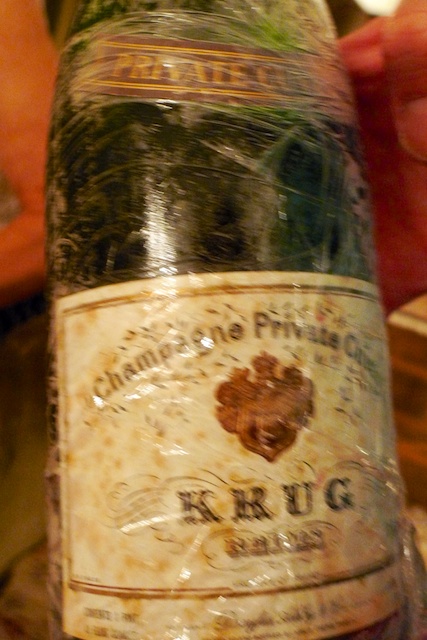
Frankly, I'm not sure if the Krug Private Cuvee we drank is the same as Krug's Grand Cuvée. I assume it is. This bottle, according to Paul, is circa late 1960s which would put it at close to 50 years since disgorgement. Still very refreshing, with no sign of tiring. It has Krug's luxurious richness--plush velvet and hand-stitched leather--and refinement.
(Notes from the group: On the nose, a touch of yeast, a touch of orange and rose petal, and almost a bit of Bordeaux mustiness/mushroomy quality. In the mouth, bacon fat, bone marrow feel. Fresh, not super long, but very nice. Superb wine, beautiful.)

From the kitchen came out a decadent plate of bone marrow on toast, and along with it two bottles of old Sherry. This is one of the most delightful pairings I've learned from Ben and Mayon. The Osborne Amontillado was perhaps bottled in the late 1950s through early 1960s. Bone-dry with caramel toast and toffee flavors, raw and aggressive on the palate. The fatty bone marrow seemed to soften the Osborne's rough edges.
A smoother Amontillado was the A.R. Valdespino Rare Amontillado Signature Series. Kevin read out the back label which said that it was bottled after aging for 106 years! Not surprising since Valdespino is one of the oldest bodega in Jerez. Very smooth, with spicy, licorice notes, more off-dry, hinting of Madeira. This is very, very good.
(Notes from Kevin: Orange/dark amber colour, moderately aromatic with a little sandalwood, good concentration dry but not bone dry, excellent length, wood, menthol, coffe grounds, excellent length,acidity good with a certain mildness that while made for a nice mouth feel, a little more acidity would have sealed the deal for me. Still pretty high end. Only 100 cases made

A juicy plate of crisp tempura soft-shell crabs accompanied the flight of two white Burgundies. The younger 2004 William Fevre Chablis Les Clos I've enjoyed a few times before and after release, including once at the domaine and also at a trade tasting where it was presented side-by-side with the Les Preuses. I confess I'm more of a Les Preuses fan, but the Les Clos is absolutely marvelous. Still tight, but maturing into a more elegant Chablis. Sharp, fresh, and racy with a lot of power in reserve.
(Notes from the group: Chablis lemon oil, acid, and harshness is beautifully integrated, richness has emerged, with a silky minerality that is very rare. Probably close to peak, no flabbiness, but the rich oily component is there.)

A candidate for wine of the night is the 1977 Domaine Leflaive Puligny-Montrachet Clavoillons. I must say one thing before talking about this wine. Every time I get a chance to drink Domaine Leflaive pre-1990 I'm never disappointed. In fact, I'm not sure if there was any quality improvement at all after 1989 when the tandem of Pierre Morey and Anne-Claude Leflaive took over from the previous regime, and the vineyards were later converted to biodynamics. Though the domaine cites 1717 as its start, in actuality the domaine was created in 1920 when Joseph Leflaive together with his right-hand man, François Virot, planted vines and bottled under the estate's label for the first time. From 1920 to 1989 François Virot and his son, Jean, who succeeded him, were effectively directing the estate's operations, both in the vineyard and cellar. After Joseph Leflaive's passing in 1953, his sons Vincent and Jo took over, but they never lived in the estate at all, leaving most operations to François and his son.
I relate this background on the domaine because Domaine Leflaive is so famous today and its wines, especially older vintages much sought-after. Everyone knows the Leflaives, even Pierre Morey, but few know about the Virots, especially François (save for Burgundians and insiders), who was one of Burgundy's greatest vignerons.

The 1977 Clavoillons had a breathtaking freshness, its Puligny fruit pure and precise. With time in the glass it only brightened. Notes of hazelnut, lime citrus oil, and plenty of mineral. Long and elegant on the palate with a distinct trail of spice. From a crappy vintage in Burgundy, this is a triumph!
(Notes from the group: On the palette , rich round, opulent. Lemon, citrus oil, boytritus, white flower. Fruit is in the background, but jasmine, white peach, apricot, lime, moving to tropical fruits, but not over ripe.)

A preliminary red was a bottle of 1984 Château Margaux, which was much better than one might expect from a vintage that is skipped by experts when discussing Bordeaux vintages. It had a good concentration, clean flavors without funk, and altogether well-balanced and a pleasant drink. It is evident that the estate, which suffered during the '70s and ended being sold, was on an upward trajectory already.
(Notes from the group: Great color, tobacco, elegant On the nose, violet, iron and rose petal. Mouth feel is a touch thinner than you would expect, but elegant, silky and quite lovely. Fruit is ripe, but just starting to dry, a touch of cedar, medium length.)

Looking at the two bottles of Château Palmer, one from 1929 and the other 1970, the difference is not only striking but there seems little if any continuity with the labels. The ownership of the estate was different for each vintage. Yet despite all these incongruous externalities, Palmer is Palmer. I confess to a bias, it is one of my few favorite Bordeaux. Its distinctive quality carries through in both vintages, with its delicate richness, leafy violet scents, and plush texture. The 1970 Palmer, leaner than examples I've had on previous occasions, therefore more elegant and precise, has good concentration, a sumptuous palate, and really gorgeous tea leaf, autumnal aromas. It remains fresh and showed no sign of tiring. The 1929 Palmer is even leaner and sinewy. The aroma is still bright and perfumy and the palate remains refreshing, and though the fruit is past its prime the wine still conveys Palmer's class and elegance.
(Notes from the group: 1970 Palmer. Classic margaux elegance and perfume, a touch of gaminess on the nose. Iron, terroir, dark/black fruits, deep rich mulberry, boysenberry black cherry. A nice grapiness, which is unusual. good length, mouth filling and lovely. 1929 Palmer. Tannins fully integrated, in the background, with a touch dryness, but very balanced, acids in the background. Soft, sweet, luscious, opulent.)

The red Burgundy flight consisted of the Grivots, a 1996 Jean Grivot Richebourg and a 1929 Moillard-Grivots Grands Echezeaux. These producers aren't really related, but then again in Burgundy one doesn't really know.
I find the 1996 Jean Grivot Richebourg still very tight, as many 1996s have shown to be. Grivot usually takes even longer than others to yield, yet there is very good promise here, as the fruit is fleshy and concentrated, high-toned as always with Grivot and quite firm.
(Notes from the group: Tight, lean and green on the nose, flawed by the competiton, not the winemaking. Still way to young. Richness is emerging, but a touch of acid, minerality, medicinal and herbal.)
Moillard-Grivot is an old negociant in Nuits-St-Georges that started around 1850 and made a ton of money exporting to Belgium. It still exists to this day. In its heyday under its various arms--Thomas-Moillard, Charles Thomas, Maison Moillard--Moillard-Grivot was one of the major vineyard owners in the Cote d'Or and the company still exists to this day. The 1929 Moillard-Grivot Grands Echezeaux was surprisingly fresh and tasty. A gorgeous wine for its velvety dark fruits tinged with spice and coffee.
(Notes from the group: Sweet baked (but not cooked ) red fruits, almost a rhubarb or strawberry pie characteristic. Palette is soft sweet, with good acidity long, mouth coating and a bit prickly or bramblely, artichoke, but fitting for the wine.)

With the dessert a 1977 Chateau d'Yquem appeared. It was good and tasty but, of course, with Yquem one always expects Valhalla and this vintage doesn't quite get you there.
(Notes from the group: Nose is rocking, but taste seems off for the nose A touch out of balance? Caramel, burnt sugar on the sides and back of palette.)
But a major distraction for me was an interloping bottle of 1748 Justino Henriques Verdelho Solera! I don't know when this was bottled but it was definitely old. Amber-tawny hued, off-dry, high-toned and fresh. Dried apricot, toasted nuts, and malaga ice cream. Long and sustained mid-palate and an almost endless finish. What a rare masterpiece! Unquestionably the most unforgettable wine of the night. I can totally relate with Antonio Galloni of The Wine Advocate when he said in his notes about this wine: "Quite frankly, I had hard time moving on after tasting this elegant, complete wine." Madeira this good is indeed the king of wines.

You know it's a special occasion when Kevin pulls out his finest party threads from the closet even prior to Halloween. He was absolutely smashing in red! Our gratitude to Ben and Mayon for a memorable treat and for making us feel at least for this one night members of the exclusive club of '29ers.


